Post #3: Tournament Preparation
“A Nerd’s Guide to Taking All the Fun Out Of a Disc Golf Tournament!”
"Hi, my name is Bill Erdley, and I am a Dataholic."
I have been working in the IT industry for ... well... longer than I care to think about. And one of the things that I have discovered is that I like to analyze data. Give me a pile of numbers, tell me to find a pattern, and I'll be obsessively occupied for days! And, of course, I can find data to analyze in the most mundane of places... like, for example, the disc golf course!
OK, that's probably not how you thought the introduction to a blog entry entitled "Tournament Preparation" was going to read, but stick with me here, and I'll show how one actually related to the other.
Tournament preparation, for me, isn't just making sure that the discs are in the car and that I have lunch in the cooler; it's about doing what I can to improve my chances of succeeding on the course. Not from the perspective of mechanics and form -- which should be addressed during field work -- but from the perspective of understanding the subtleties of the course and the competition, and setting the expectations in your head that will help you stay focused AND relaxed during the tournament rounds themselves.
Preparation begins with some basic questions:
Is there historical data on past tournaments?
Have I played this tournament before and/or have I played this course before?
This is where my data-mining personality kicks in.
Starting with the first question; my goal is to gather round scores and holes statistics from the past 5 or 6 years of tournaments. “5 or 6 years” is an arbitrary duration which gives me a good base of data from which to begin. Using the PDGA.com website, I copy down the scores and ratings from any tournaments that I find for that course on the specific layout that is being used for the upcoming tournament.
For example, my next tournament is at Lums Pond State Park near Bear, Delaware. Looking at the PDGA.com website and searching through the past events, I found 8 tournaments in the last 5 years at Lums Pond.
(NOTE: All of the rounds were labeled as taking place on the "Default Layout." I am using the assumption that my upcoming tournament will use the same layout. We will see how valid that assumption is after the weekend...)
I build a spreadsheet with the reasonably possible scores down the left side, followed by columns for calculated average, minimum rating, and maximum rating for that score (Image #1). Then I create a column for each tournament that I found, and enter the score ratings in the appropriate row, corresponding to each score (Image #2). After I enter all of the ratings for a tournament, I use mathematical patterning to fill in any missing ratings (Image #3). Each time I add a new tournament, the calculated values change. When I am finished, I can see the average (and min/max) rating for each score for that course.
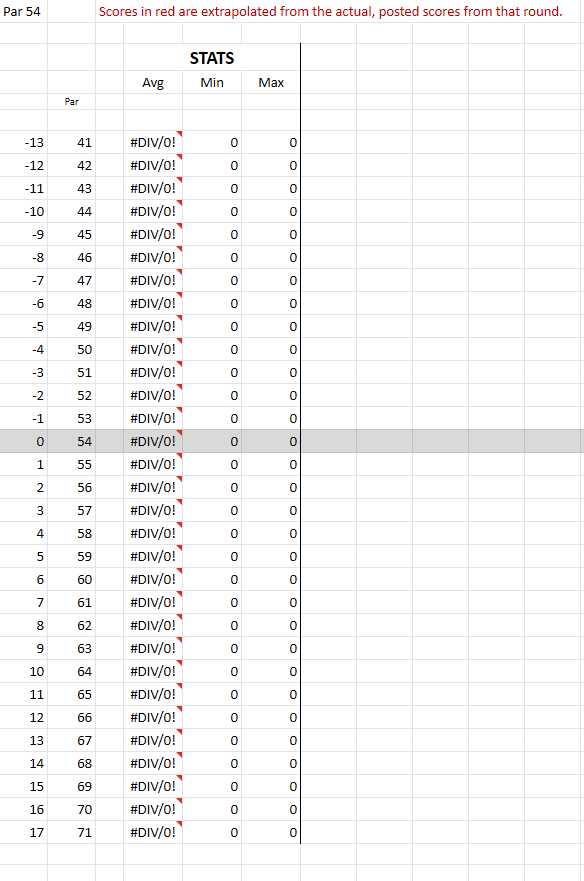
Image #1 - Possible (reasonable) scores and calculated columns
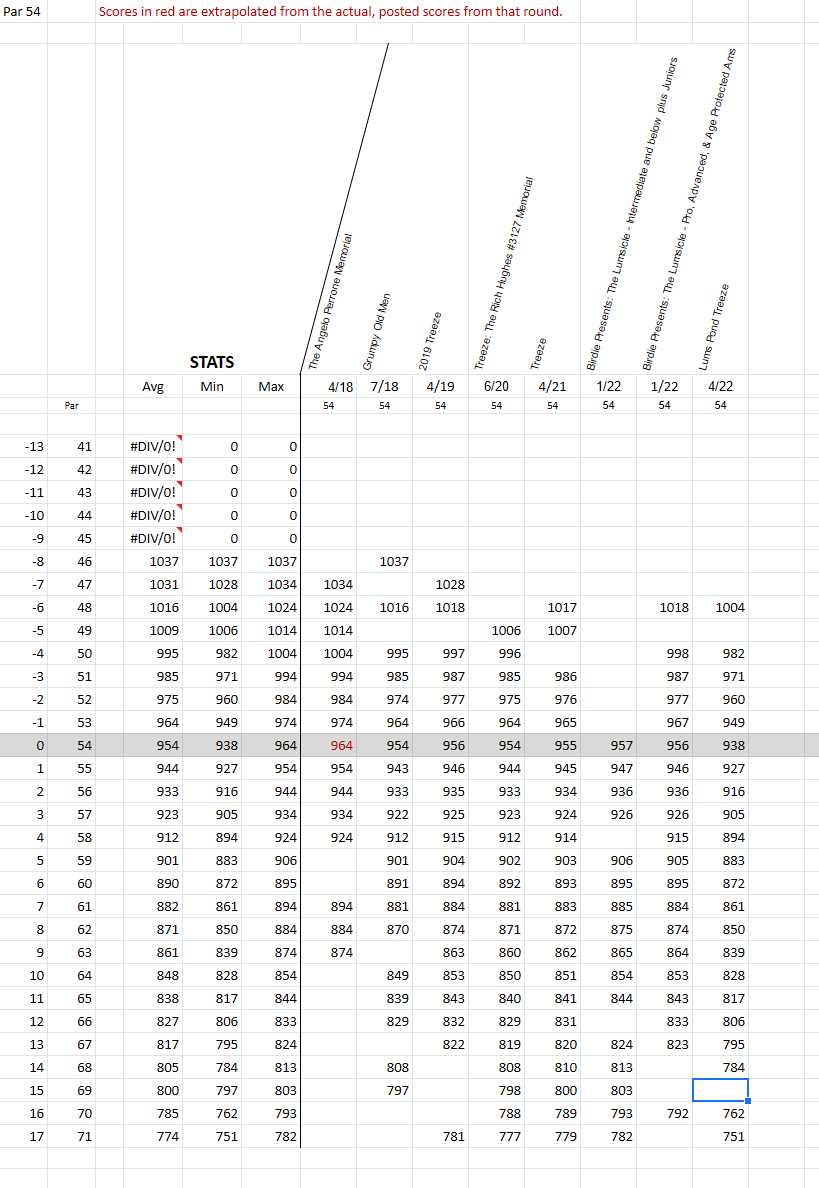
Image #2 - Ratings data from all of the “Default Layout” tournaments at Lums Pond
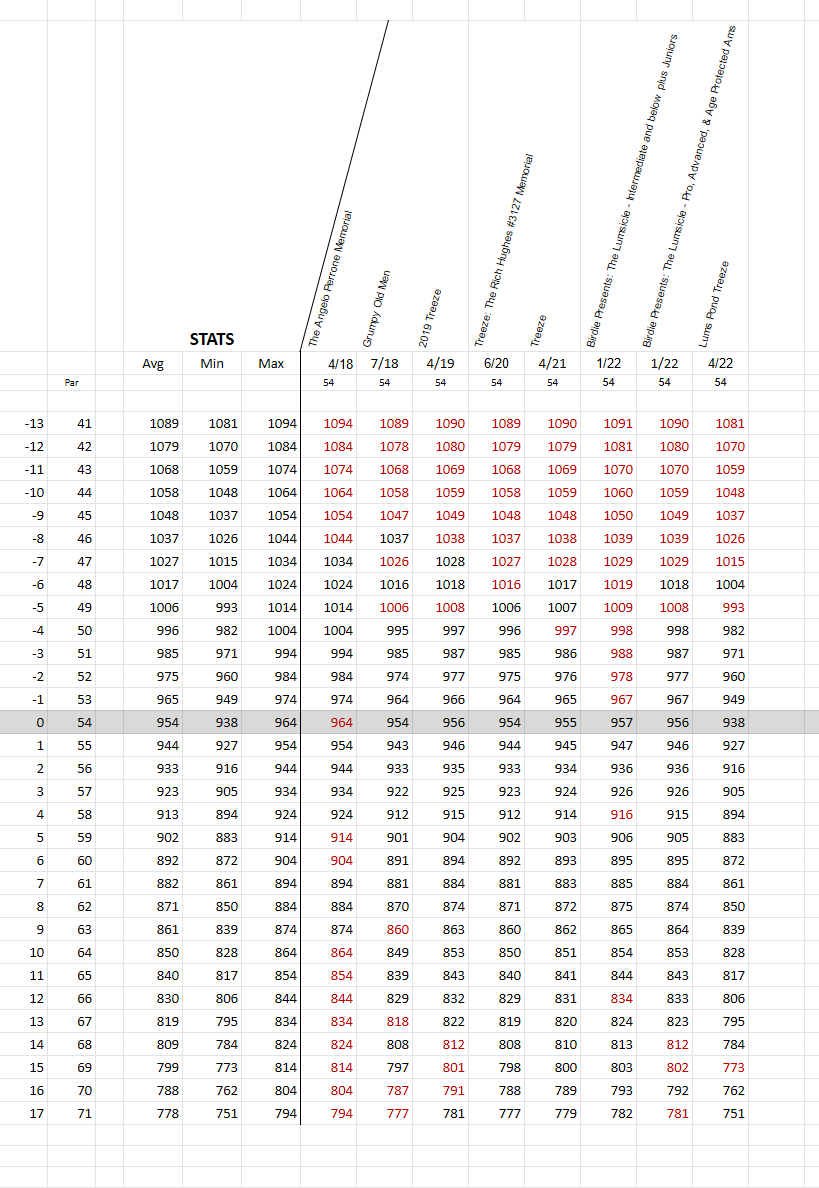
Image #3 - Missing ratings filled in using mathematical patterning
What does that do for me, you ask? It helps me a couple of ways. First, it gives me an overall idea of the difficulty of a course. If the course is a par 60, and even par has an average rating of 980, then I know that the course is pretty difficult; whereas if even par has an average rating of 920, then there's a pretty good chance that the course is fairly easy. Next, it helps me set my own expectations. On paper, my current rating is 902, so with the spreadsheet that I created for Lums Pond, a +5 (59) currently has an average rating of exactly 902. Now, in my head, I should be shooting at around a 940-rated round, so to do that, I would need to shoot a +1 (55).
The data set gets even deeper if I've played rounds at the course/layout in question. In that case, I also create another spreadsheet breaking down the layout by hole and list each of my rounds, with average values calculated and "target" values entered for each hole. (A "target" value is what I think I should reasonably be shooting on that hole.) This gives me even more information by which I can manage my own expectations. (Image #4 — taken from my data on Iron Hill - Gold Layout since I’ve never played a round at Lums Pond.)
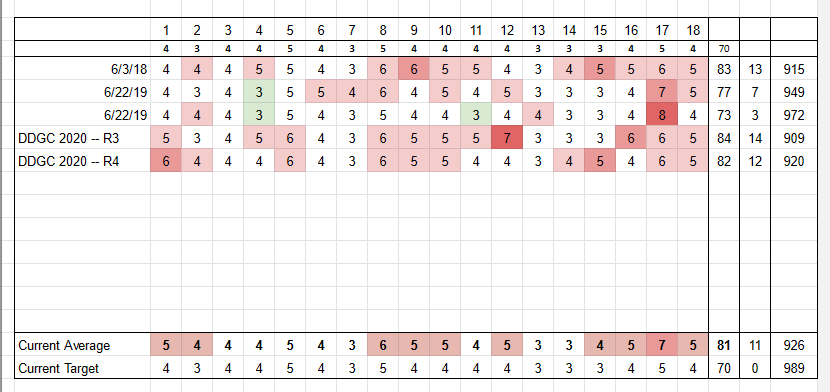
Image #4 - Data from rounds played
Coming Up With a Game Plan
Once the nerd in me has been satisfied, I move on the the actual course preparation itself. Hole by hole, I will game plan my strategy for each round, looking at probable landing zones, danger zones, and obstacles. If I have played the course before, this part of the tournament prep is much easier, since I can rely on memory and personal experience; otherwise, I need to use video footage of past tournaments, course photographs, and any other second-hand info that I can find. I will also think through probable disc selection for each shot -- keeping in mind that (to bastardize a phrase from Mike Tyson) "everybody has a plan until they get kicked into the trees!" Since I will be playing the Lums Pond tournament blind, I used a few videos that I could find, as well as images from DiscGolfCourseReview, to do the best that I could. Here are my first few holes as an example:
Hole 1 - 388 ft
Throw to the edge of the woods (~ 280); stay slightly right for angle to pin
King/Sword drive; Warship approach
Hole 2 - 189 ft
Image looks to have alternative fairway right
Warship center or Bard right
Hole 3 - 269 ft
Tunnel, straight (~130) then fade left
Warship drive, then Warship/Bard approach
Hole 4 - 417 ft
Full drive; OB (~300); approach straight
Sword/King drive; Warship approach
Hole 5 - 271 ft
Gentle right turn
Forehand bowman/Fortress drive; Warship approach
Hole 6 - 330 ft
Fill backhand drive (Mando left); stay slightly left for angle to pin
King/Sword drive; Warship/Bard approach
...
The Night Before
Call it a foible of personality or a fact of biology -- either way, I don't wake up quickly or easily. So I will do as much of my physical tournament prep the night before. And I'm not kidding -- this is the list:
Clothes:
first round apparel
extra shirts x2
extra socks x3 pairs
extra shoes x2 pairs (1 for extra support for bad footing)
towels; x2 per round on dry days, x4 or 5 per round if wet
depending on weather conditions
extra sweatshirt \ jacket
raincoat
gloves \ handwarmers \ disc golf hand muff (made by a local disc golfer)
dry clothes for the drive home
Equipment:
discs in course bag
discs in practice bag
extra \ replacement discs depending on course layout and conditions
mini marker
pencils and Sharpie pen
Cart:
GoPro (w SD cards x2) - fully charged
GoPro cart mount
extra battery packs x2
charging cords for phone and GoPro
phone cart mount
Food:
lunch
2 full water bottles
1 full ice bottle
course snacks
All of this is prepped the night before and packed into the car (if possible), so that I can roll out of bed, stagger into my clothes, crawl behind the wheel, and sleep-drive to the tournament (just kidding... but not by much!)
Sleep!
Lets face it, I'm at the age that we all used to joke about; where the old folks would toddle into a restaurant at 4:00 pm for dinner, then head home for their nightcap of Geritol and in bed asleep by 7:00 pm. Except that we rarely eat in a restaurant on a Friday or Saturday night (too "people-y!"), and by the time all of my prep is done, the animals are dealt with (the human one as well as the non-human ones!), and I finally run out of things that need to be done, it's WAY past 7:00 pm! And normally, I'm awake by 5:30 or so simply because my body is used to that during the week. So even though I try to get 8 hours of sleep the night before a tournament, it doesn't always happen. But I try.
That's basically how I get ready for a tournament. Some require more effort than others. I'll sometimes even try to play a practice round at the tournament course in the weeks before the event just to get a feel for the course in it's current state. And, of course, all of this prep doesn't necessarily mean that I'm actually READY for the tournament when it arrives -- but this is how I try to give myself the best chance of success that I can manage.