Blog Post: Course Statistics
… or …
Tournament Preparation, Data Mining, and Geritol!
I have been asked about the statistics that I use in my tournament prep; where they came from, how I got them, how they work, etc. While answering those questions, it has begun to dawn on me that other players may find some use for this data and, perhaps to a lesser extent, my analysis. Since I have begun to back away from creating videos of tournament rounds ( too much distraction, both for myself and for the others on my cards ), providing some of this data may just fill that gap. However, the sheer volume of data that I have collected ( 10+ years of rated tournament rounds for 42 course layouts over 26 courses ), plus the effort that it will take to convert (and maintain) this information in a format that can be viewed on this website, means that it will take me a ridiculous amount of time to get it all posted. My plan is to create a new section on the website ( called something pithy like “Statistics” or “How Bad Am I Really?” ), and fill in the course data as I can — probably starting with the data for the courses where I have upcoming tournaments, since I’ll already be looking at that data.
Creating the Data Sets -- or -- "Yet Another Time Sink!"
(This content is a reprise of a post from my original website.)
"Hi, my name is Bill Erdley, and I am a Dataholic."
I have been working in the IT industry for ... well... longer than I care to think about. And one of the things that I have discovered is that I like to analyze data. Give me a pile of numbers, tell me to find a pattern, and I'll be obsessively occupied for days! And, of course, I can find data to analyze in the most mundane of places... like, for example, the disc golf course!
Tournament preparation, for me, isn't just making sure that the discs are in the car and that I have lunch in the cooler; it's about doing what I can to improve my chances of succeeding on the course. Not from the perspective of mechanics and form -- which should be addressed during field work -- but from the perspective of understanding the subtleties of the course (the "competition"), and setting the expectations in your head that will help you stay focused AND relaxed during the tournament rounds themselves.
Preparation begins with some basic questions:
Is there historical data on past tournaments?
Have I played this tournament before and/or have I played this course before?
This is where my data-mining personality kicks in.
Starting with the first question; my goal is to gather round scores and holes statistics from the past "10-ish" years of tournaments. “10-ish” is an arbitrary duration which gives me a good base of data from which to begin. Using the PDGA.com website, I copy down the scores and ratings from any tournaments that I find for that course on the specific layout that is being used for the upcoming tournament.
I build a spreadsheet with the reasonably possible scores down the left side, followed by columns for calculated average, minimum rating, and maximum rating for that score (Image #1). Then I create a column for each tournament that I found, and enter the score ratings in the appropriate row, corresponding to each score (Image #2). After I enter all of the ratings for a tournament, I use mathematical patterning to fill in any missing ratings (Image #3). Each time I add a new tournament, the calculated values change. When I am finished, I can see the average (and min/max) rating for each score for that course.
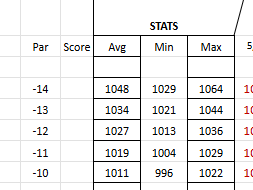
Image #1 - Possible (reasonable) scores and calculated columns
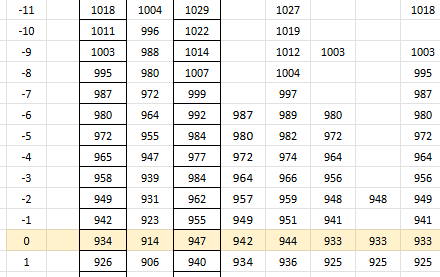
Image #2 - Insert PDGA ratings data
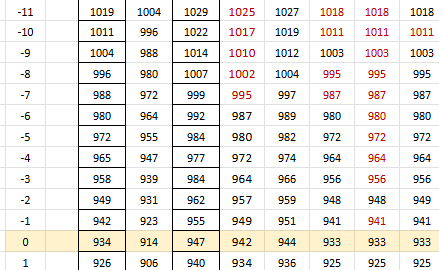
Image #3 - Missing ratings filled in using mathematical patterning
What does that do for me, you ask? It helps me a couple of ways. First, it gives me an overall idea of the difficulty of a course. If the course is a par 60, and "even par" has an average rating of 980, then I know that the course is pretty difficult; whereas if "even par" has an average rating of 920, then there's a pretty good chance that the course is fairly easy. Next, it helps me set my own expectations. On paper, my current rating is ~900, so with the example spreadsheet that I created, a +4 (73) currently has an average rating of 903. Now, in my head, I should be shooting at around a 940-rated round, so to do that, I would need to shoot a -1 (68) — currently rated at 942 (avg).
The data set gets even deeper if I've played rounds on the course/layout in question. In that case, I also create another spreadsheet breaking down the layout by hole and list each of my rounds, with average values calculated and "target" values entered for each hole. (A "target" value is what I think I should reasonably be shooting on that hole.) This gives me even more information by which I can manage my own expectations. (Image #4)

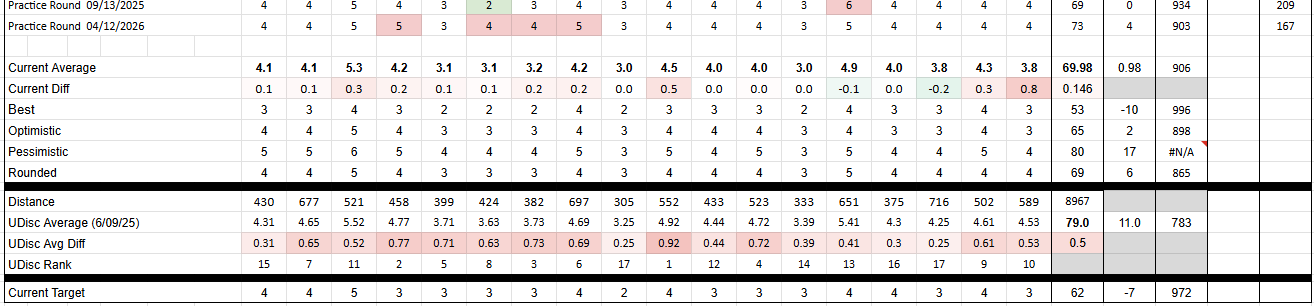
Image #4 - Data from rounds played
Coming Up With a Game Plan
Once the nerd in me has been satisfied, I move on the actual course preparation itself. Hole by hole, I will game plan my strategy for each hole, looking at probable landing zones, danger zones, and obstacles. If I have played the course before, this part of the tournament prep is much easier, since I can rely on memory and personal experience; otherwise, I need to use video footage of past tournaments, course photographs, and any other second-hand info that I can find. I will also think through probable disc selection for each shot -- keeping in mind that (to bastardize a phrase from Mike Tyson) "everybody has a plan until they get kicked into the trees!" Here are my first few holes, using my example data -- and the Muddy Run Gold course -- as an example:
Hole 1 : Par 4 : 430 ft
Drive: (BH) King to base of rise
Approach: (BH) Stag/Hatchet to green
Hole 2 : Par 4 : 677 ft
Drive: (BH) King to mid-fairway
Approach: (BH) Bear/Stag to green
Hole 3 : Par 5 : 521 ft
Drive 1: (BH) Bear to left dogleg
Drive 2: (FH) Sword/Adder to top of rise
Approach: (BH) Bear/Stag to green
Hole 4 : Par 4 : 458 ft
Drive: (FH) Adder to Silver teepad area
Approach: Warship to green
Hole 5 Par 3 : 399 ft
Drive (FH) Sword to green
Hole 6 : Par 3 : 424 ft
Drive: (BH) Underworld/Hatchet to green
That's basically how I get ready for a tournament. Some events require more effort than others. I'll sometimes even try to play a practice round at the tournament course in the weeks before the event just to get a feel for the course in it's current state. And, of course, all of this prep doesn't necessarily mean that I'm actually READY for the tournament when it arrives -- but this is how I try to give myself the best chance of success that I can manage.
Let’s face it, I'm at the age that we all used to joke about; where the old folks would toddle into a restaurant at 4:00 pm for dinner, then head home for their nightcap of Geritol and be in bed asleep by 7:00 pm. (Except that we rarely eat in a restaurant on a Friday or Saturday night -- too "people-y!"), and by the time all of my physical prep is done (equipment, food, etc.), the animals are dealt with (the human one as well as the non-human ones!), and I finally run out of things that need to be done, it's WAY past 7:00 pm! And normally, I'm awake by 5:30 or so simply because my body is used to that during the week. So even though I try to get 8 hours of sleep the night before a tournament, it doesn't always happen. Having this kind of information all figured out ahead of time makes me feel like I have a handle on the tournament — even when I don’t.